Metal prices
What each metal in a car is worth to you per pound, and the weights each price is paid on.
Your metal prices are what your buyers pay you, per pound, for the steel, wheels, battery and wire harness in a car. Every offer starts from them. Enter them as your buyers quote them, and update them when your buyers' prices change.
Metal prices
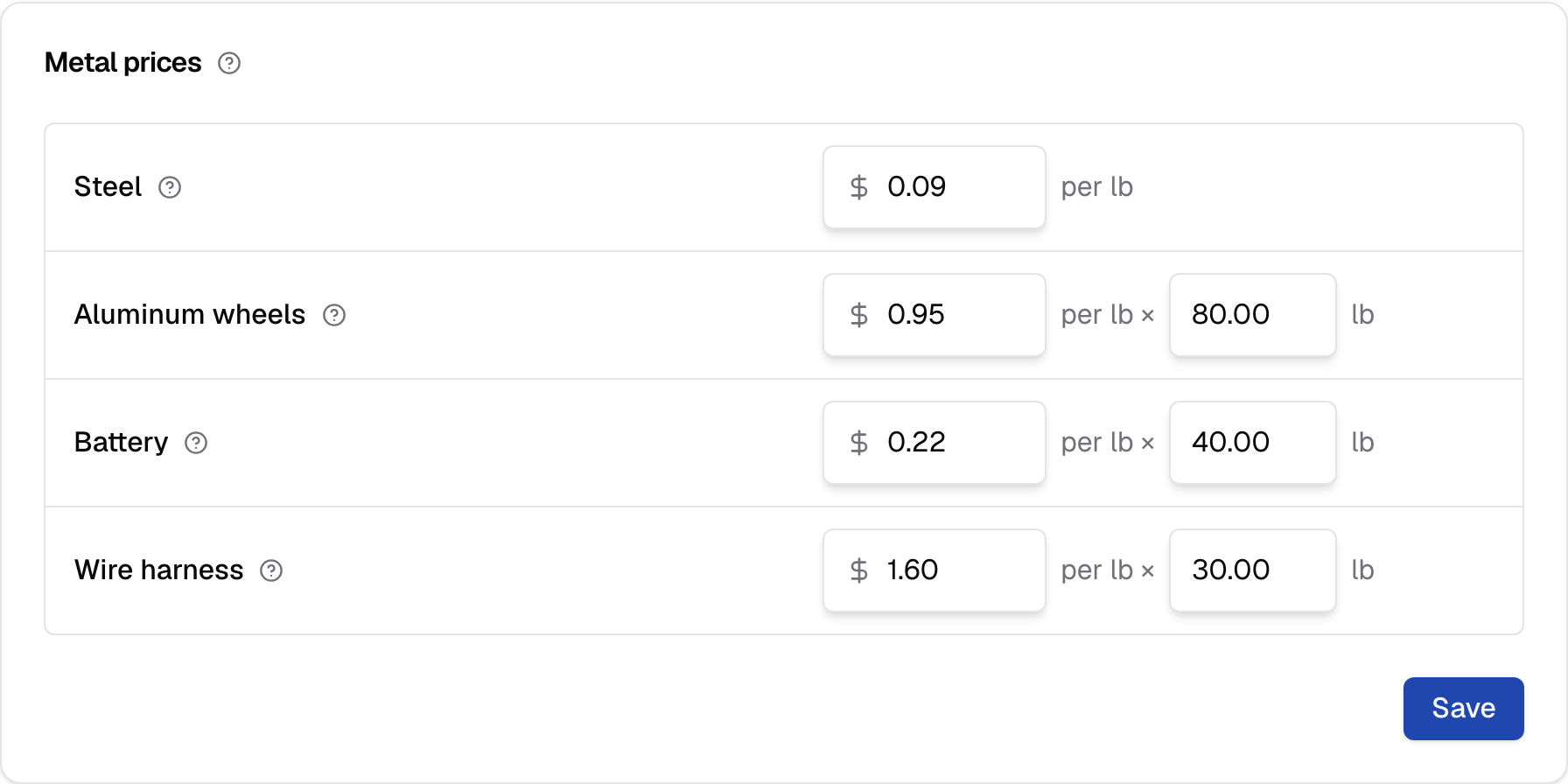
What you're paid per pound for each metal in a car, and the weight each is paid on. Every new offer starts from these; offers already made keep their prices.
Prices go from $0 to $10 per lb, to four decimal places, as buyers quote them ($0.0915). Weights go from 0 to 1,000 lb, to a hundredth of a pound. A blank saves as 0.
A number outside its range, or with more places than that, is refused and nothing on the card is saved:
- "Enter a price from $0 to $10 per lb, to a hundredth of a cent."
- "Enter pounds from 0 to 1,000."
Fix the box marked and press Save again. Your other numbers stay as you typed them.
The card saves only its own prices and weights: the bid multiple and the diesel truck add are saved on their own cards.
Every offer prices a complete car. A dead battery or a missing wheel is an answer on your form that takes dollars off, not something left out here.
Steel
What you're paid per pound of steel. Every offer multiplies it by the car's shell weight: its curb weight less the wheels, battery and wire harness weights below.
The curb weight comes from our vehicle list for the year, make, model and trim the seller picked. Because the weights below come off it first, a heavier wheel, battery or harness weight leaves less steel.
Aluminum wheels
What you're paid per pound of aluminum wheels, and what a set of four weighs. Added only for cars our vehicle list shows on aluminum wheels.
The pounds box after the price is the weight of all four wheels. It comes off every car's shell weight, whatever its wheels, so a car on steel wheels gets no wheel line and its wheel weight isn't paid as steel either.
Battery
What you're paid per pound of battery, and what one battery weighs. Every offer adds it, since every car is priced complete.
The pounds box after the price is one battery's weight. It comes off the shell weight, then is paid at this price.
Wire harness
What you're paid per pound of wire harness, and what a car's harness weighs. Every offer adds it, since every car is priced complete.
The pounds box after the price is the harness's weight. It comes off the shell weight, then is paid at this price.
These are next period's prices from our buyers
Tick it when the prices you're saving are your buyers' new prices. Saving then ends every downturn cut, and offers go back to your prices as entered.
This box shows only while a downturn cut is in force. The card then opens with Downturn cut in force, naming each cut, for example "Offers are using 3.2% off steel."
While a cut is in force:
- The prices on this card are still your buyers' prices. The cut comes off when an offer is made, so you never type a cut price here.
- Saving a correction without the box ticked keeps the cut.
- Saving with the box ticked ends every cut in the same save, and your site says "Saved. Downturn cuts cleared." Change history records it as entering next period's buyer prices.
Tick it only when your buyers have given you new prices. Ticking it with the same prices still ends the cuts, and offers go back to paying full price for steel and aluminum wheels.
The 45-day reminder
A cut that has been in force for more than 45 days stays until you do this. The Downturn hedge page then shows Enter your buyers' prices, with a link back to this card.
Staff
Staff see these prices and weights, and the box while a cut is in force, but can't change or tick them. There's no Save on the card for Staff.